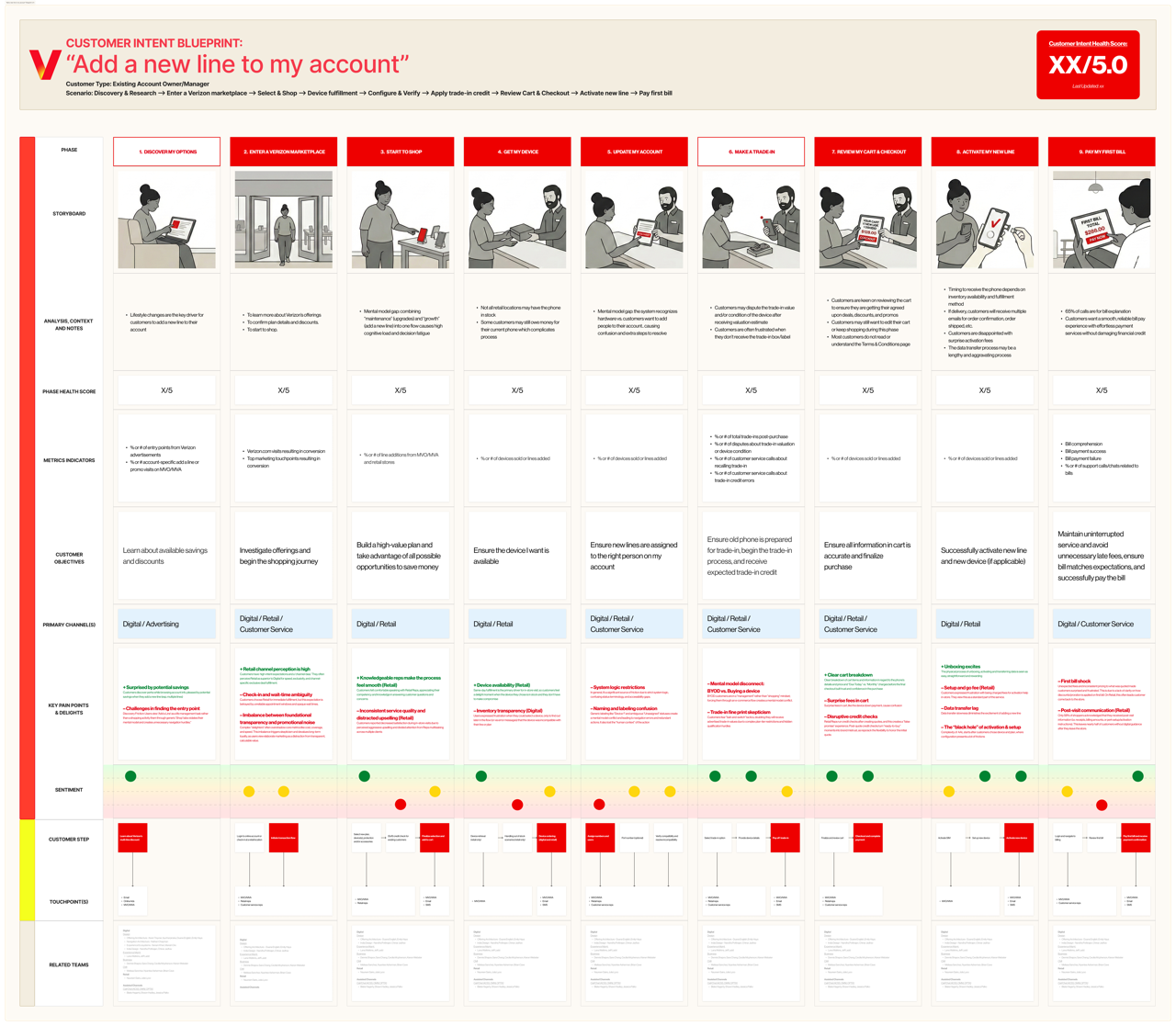
Verizon's Customer Intent inventory includes 70+ discrete customer goals, but only a handful had been mapped into full blueprints. "Add a New Line to My Account", one of Verizon's most common customer intents, had never been blueprinted end-to-end, leaving no central resource for teams designing across its many touchpoints.
Emily and I set out to close that gap: build the first working blueprint for this intent, and in doing so, establish a proof-of-concept framework other teams could use to blueprint their own intents independently going forward.
Customer Intent is Verizon’s internal framework for organizing customer needs around what they are actually trying to accomplish during their interactions with Verizon, rather than around internal product verticals or channel structures. It encourages Verizon team members to approach problems from the customer’s lens and act accordingly, rather than focusing on siloed business objectives.
By the time this case study was written, each intent had multiple pathways documented through service blueprints and customer journey maps, and the team had documented 6 service blueprints on 6 Customer Intents.
"Add a New Line to My Account" is one of Verizon's most common customer intents, and until this project, one of its most undocument. Out of 70+ mapped customer goals, it had never been blueprinted end-to-end, leaving no central resource for the many teams designing across its touchpoints.
Scoping the journey
Emily and I defined scope early for this project, which is existing customers who are Account Owners and/or Account Managers, and those who are adding a new line to their mobile device. We deliberately excluded prospect custoemrs and Account Members, as well as Verizon Home Internet customers to keep the first blueprint tight enough to finish well, rather than broad and shallow.
Grounding in existing knowledge
Before generating anything new, we audited pre-existing assets, which are Retail’s end-to-end experience blueprints and prior Customer & Market Insights (CMI) reports. We also consulted with colleagues who had run the blueprinting process before, along with stakeholders from teams such as Identity Architecture to learn more about the account management process at Verizon, as well as the Offering Architecture team to learn more about the bill payment processes are when customer adds a new line to their account.
Auditing the current digital experience
Alongside secondary research, we conducted a digital experience audit of the existing "Add a New Line" flow where we were walking through the current screen by screen of My Verizon App (MVA) and My Verizon Online website (MVO) to document what the experience actually looked like today, not just what past research said about it. This gave us a firsthand view of some friction points before we layered in interview and stakeholder input.
Mapping the current state and creating a "Planning Matrix"
We diagrammed the full 9-step journey, from discovering the option to paying the first bill, and then we built a "Planning Matrix" as a skeleton narrative for the blueprint, before layering on pain points, delights, and sentiment at each phase. This became the foundation for the data and insights collection that followed.
Insights gathering with customers
Once we had a working draft of the journey, we went to customers directly to validate it. We collaborated with CMI where they had interviews with 12 participants who confirmed whether the phases we'd mapped matched how customers actually experienced adding a line, and surfaced additional pain and delight points we hadn't captured from secondary research or the digital audit alone.
The "Add a New Line" blueprint we developed which shows the Phases, Storyboard, Metics Indicators, Customer Objectives, Primary Channels that customers use, Key Pain Points & Delights, Sentiments, and details around Customer Steps and Touchpoints. We didn't go through assigning scores for each phase as well as the overall Customer Intent Health Score for this customer intent since that wasn't part of the scope of the project, which will require collaboration with metrics ecosystem and data analyst team.
Insights
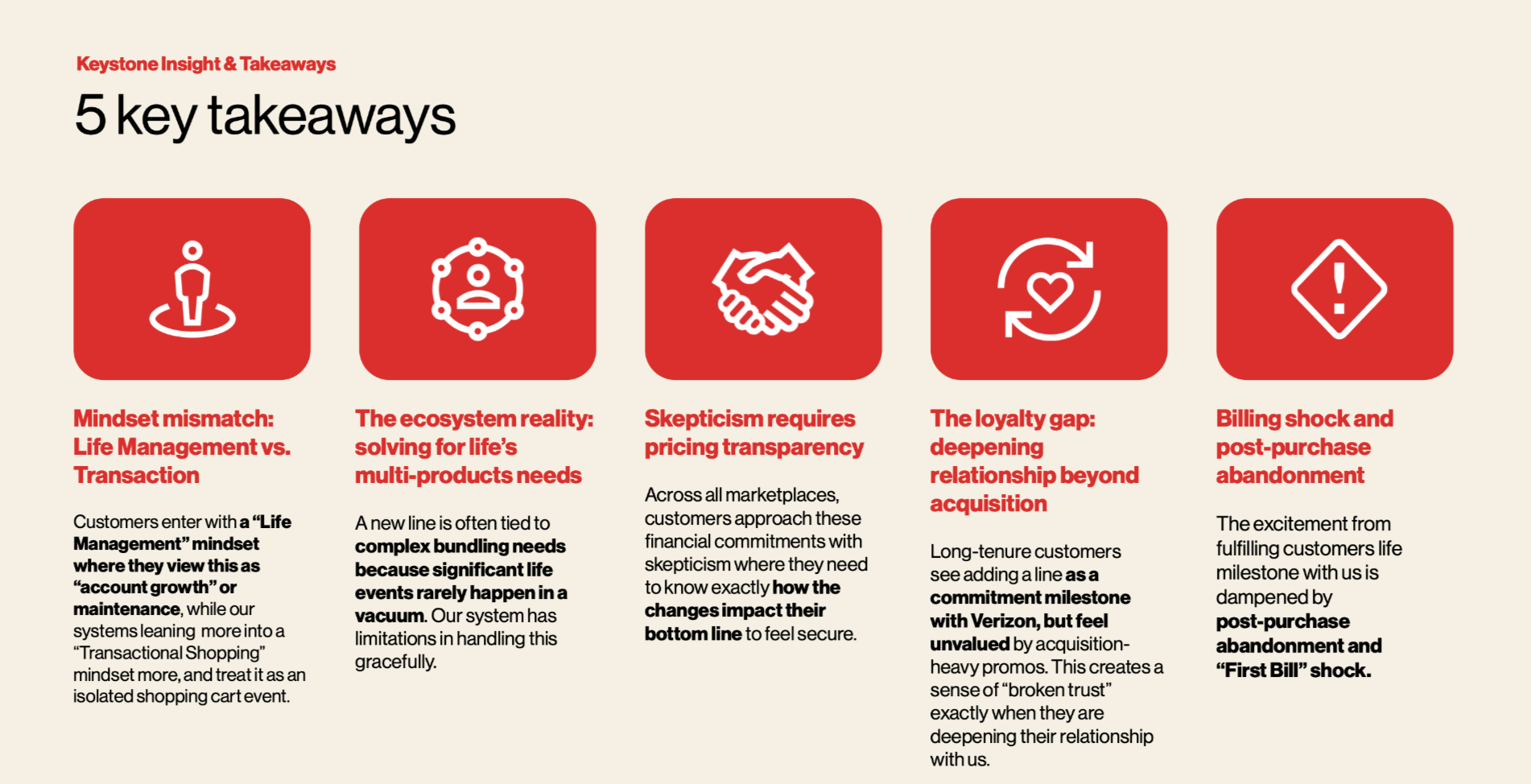
Recommendations & Next Steps
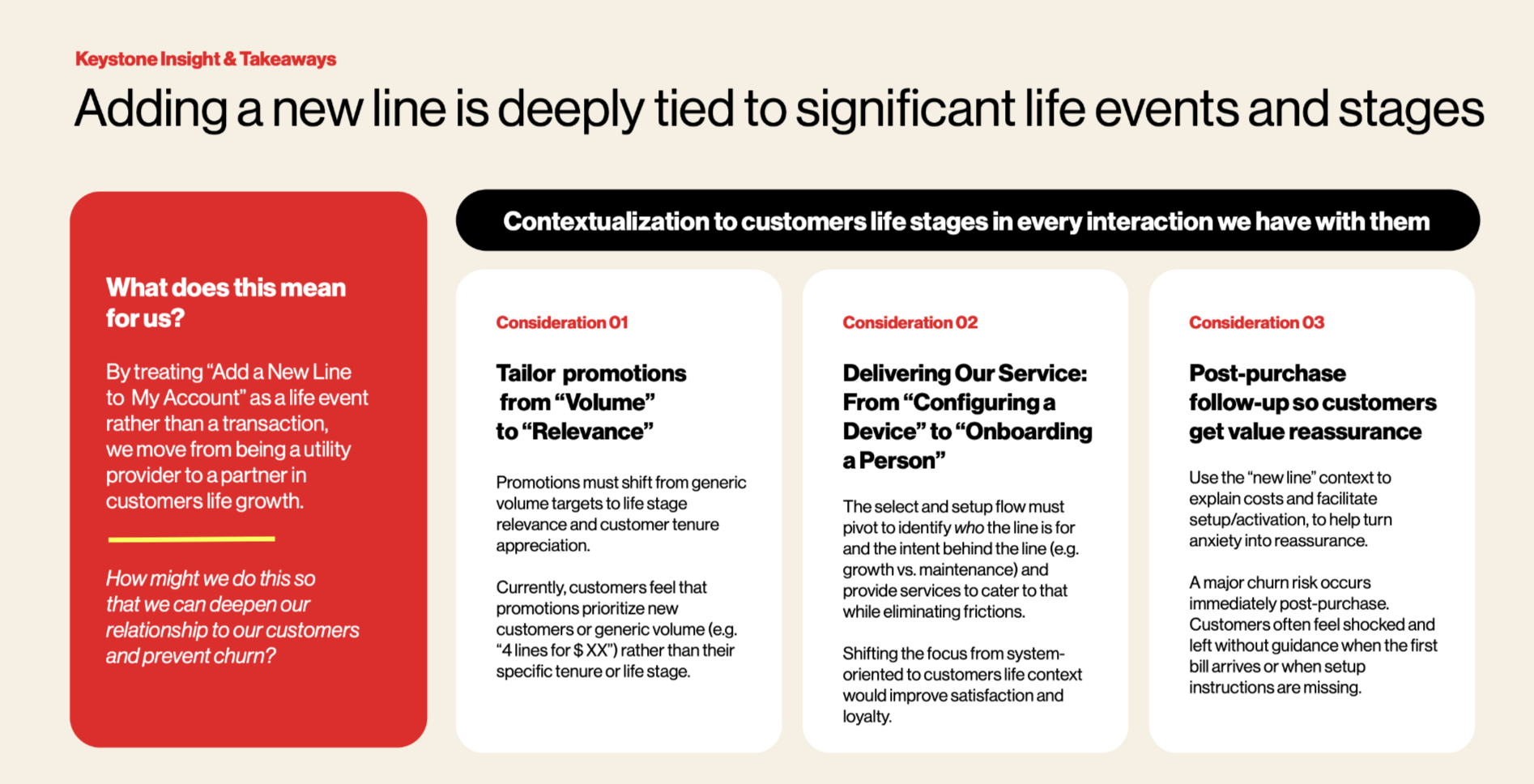
Customers see adding a line as a Life Management decision: a new job, a milestone, a growing family. Meanwhile, Verizon's systems see a transaction. That mismatch shows up everywhere, from generic device labeling to a "First Bill Shock" that catches customers off guard.
This project built real confidence in navigating a highly matrixed organization, including finding and talking to the right teams outside the Experience Architecture team (my team). It also helped me strengthen the capacity to do the slower work of locating and interpreting relevant data, where, at this scale of organization, even deciding where to start took real effort.
It also surfaced how many teams are actually involved in a single customer intent, each with different mandates and priorities that don’t always align, sometimes even at odds with each other. I also learned about how much subjective judgment blueprinting requires, because data is never complete, so developing a blueprint meant making a creative leap and having a point of view about what mattered most, and to whom.
The bigger question the process left me with is that this was a long, manual effort that would start going stale the moment we finished it. The gap between how much work a single static blueprint takes and how quickly it stops reflecting reality became the starting point for the next phase of the Journey Management work.